
Why Do the Wise Withdrawal
Understanding Schopenhauer’s Retreat From Society

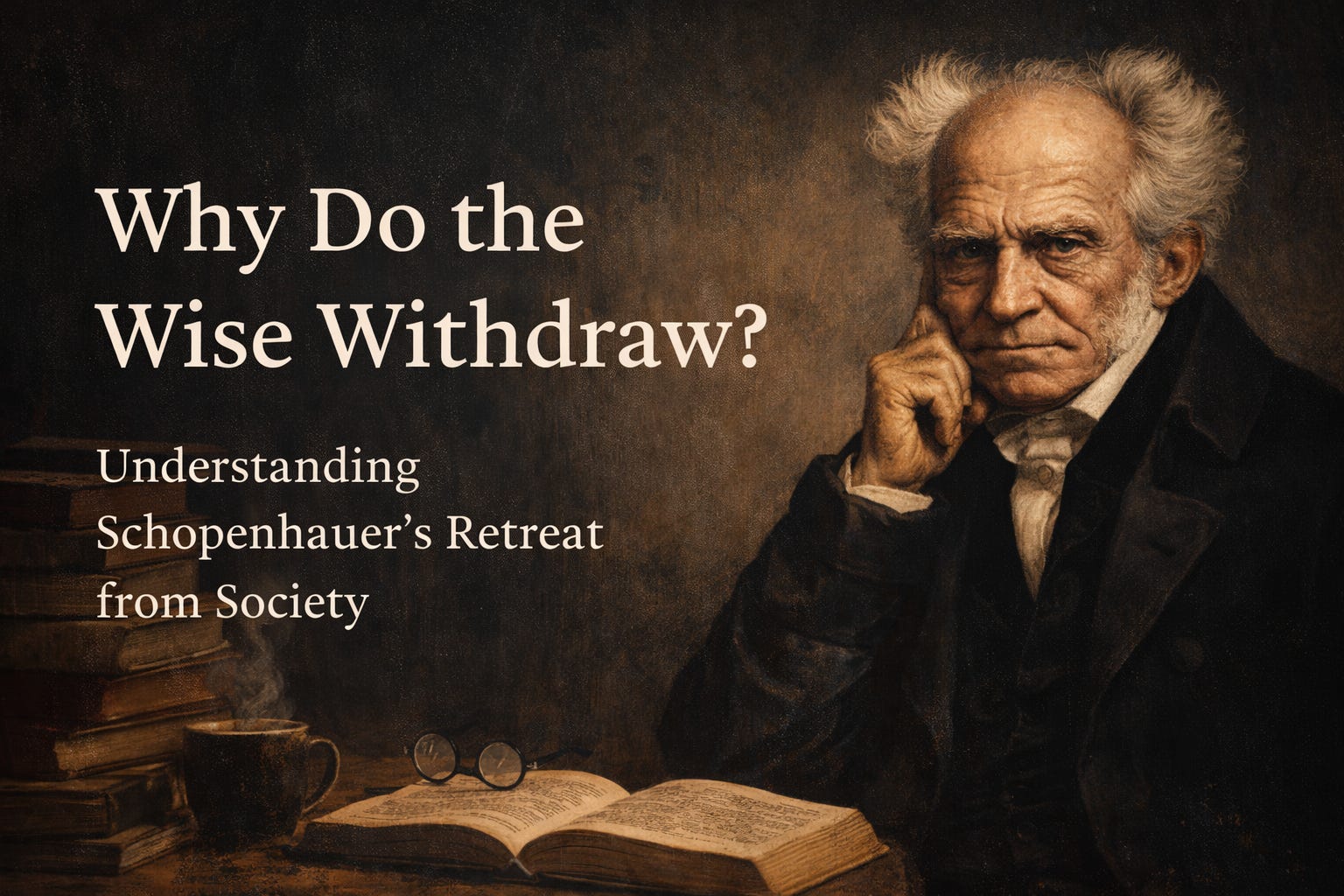
The Quiet Withdrawal of Intelligence
Is society losing its sharpest minds — or pushing them into silence?
Let me ask you a question.
Where are all the intelligent people?
Are they slowly disappearing from society?
Are they being born in fewer numbers?
Or are they still here — simply withdrawing, fading quietly into the background?
We live in an age of constant performance. Opinions are shouted. Outrage is rewarded. Speed is valued more than depth. Popularity outweighs precision. The loudest voices dominate the room, not the most thoughtful ones.
In such a climate, a troubling question emerges:
What happens to those who think too deeply?
What happens to those who question everything?
Few thinkers confronted this issue as ruthlessly as Arthur Schopenhauer. Long before the noise of modern social media, he argued that intelligence carries a psychological cost — one that often leads not to prominence, but to withdrawal.
Are intelligent people truly vanishing?
Or is society becoming inhospitable to intelligence itself?
1. Intelligence and the Instinct for Solitude
From the outset, Schopenhauer insisted that highly intelligent individuals are naturally inclined toward withdrawal.
He observed that after gaining real acquaintance with humanity, a gifted person will often choose seclusion — and if in possession of a great mind, even solitude.
Why?
Because the more a person has within themselves, the less they require from the outside world. A mind rich in ideas, imagination, and reflection does not crave constant stimulation. It generates its own.
In his blunt way, he wrote:
“A high degree of intellect tends to make a man unsocial.”
This was not an insult, but a diagnosis.
The intellectually driven person finds greater satisfaction in reflection, creativity, and deep inquiry than in idle chatter or social rituals. Small talk exhausts them. Superficial games feel pointless. Their inner world is simply more compelling.
He goes further:
“Rascals are always sociable, more the pity, and the chief sign that a man has any nobility in his character is the little pleasure he takes in others company.”
Provocative, certainly. But his meaning is clear: what society often labels as aloofness or arrogance may, in reality, be depth.
The intelligent individual does not retreat out of hatred for humanity, but out of necessity. Their internal life becomes so vivid that social interaction begins to feel optional at best — draining at worst.
Modern psychology echoes this insight. Highly gifted individuals often exist at the far end of the bell curve, where intellectual equals are rare. Conversations that excite them may bore others. Questions that obsess them may seem irrelevant to the crowd.
Schopenhauer described this split powerfully: the intelligent person eventually leads two lives — a personal life and an intellectual life. Gradually, the intellectual life becomes the true one.
And that true life requires silence. It requires distance. It requires protection.
It requires solitude.
2. When Society Feels Like Noise
If solitude feels like home to the reflective mind, society can feel like a marketplace at full volume.
Schopenhauer once declared that the worst thing in the world is society. Extreme? Perhaps. But his critique targeted something specific: social life saturated with trivial talk, distraction, posturing, and endless noise.
For many, this environment is stimulating. For the reflective mind, it can feel abrasive.
He argued that when average individuals lose their usual distractions — wealth, status, trivial pleasures — they quickly fall into boredom. They cling to noise because silence would force them to confront emptiness.
The intelligent person experiences this differently.
He does not fear silence.
He fears meaninglessness disguised as noise.
Schopenhauer drew a stark contrast between the life of the masses — which he described as a dull record of petty interests — and the life of the intellectual, rich in thought and inner vitality.
It is important to acknowledge that some of his historical examples were shaped by the prejudices of his era. Yet the underlying philosophical claim remains: those with lower intellectual demands often seek constant company, while the intellectually developed individual may recoil from it.
Not because they despise others.
But because they require something deeper.
3. Intelligence Expands Suffering
Schopenhauer’s most unsettling claim may be this: intelligence does not merely expand understanding — it expands suffering.
In The Wisdom of Life, he writes:
“With the growth of intelligence comes increased capacity for pain.”
And even more starkly:
“It is only with the highest degree of intelligence that suffering reaches its supreme point.”
This is not melodrama. It is psychological realism.
The more aware you are, the more you notice.
The more you notice, the more you feel.
The more you feel, the heavier existence becomes.
An ordinary person may brush off a disappointment. A highly intelligent person dissects it. They foresee consequences. They replay errors with painful clarity.
Intelligence sharpens perception — but it also sharpens pain.
Human life, Schopenhauer insisted, oscillates between suffering and boredom. The perceptive individual sees this tragic rhythm more clearly than others.
They notice hypocrisy others ignore. They sense absurdity beneath conventions. They recognize how many pursuits are ultimately futile.
Such awareness can be overwhelming.
Withdrawal, then, becomes a form of self-preservation — not arrogance, not hatred, but protection.
He writes:
“A man can be himself only so long as he is alone. And if he does not love solitude, he will not love freedom.”
4. The Self-Sufficient Mind
Eventually, the intelligent individual may withdraw for a simpler reason:
He no longer needs what society offers.
Schopenhauer observed that rare individuals — philosophers, creators, deeply reflective minds — build an inner world so rich that it outweighs the external one.
What most people seek externally — validation, companionship, stimulation, achievement — the intellectual increasingly finds within.
Thought becomes companionship.
Creation becomes fulfillment.
Reflection becomes nourishment.
He states:
“Undisturbed occupation with himself, his own thoughts and works is a matter of urgent necessity to such a man. Solitude is welcome. Leisure is the highest good. And everything else is unnecessary.”
Not inconvenient.
Not distracting.
Unnecessary.
Such individuals may still maintain relationships. They may love and participate. But if external ties were severed, their inner world would still sustain them.
They move among others, yet inwardly they feel separate — not superior, not hostile, but disidentified.
In their thoughts, they begin to say they instead of we when referring to humanity.
That subtle shift marks a profound psychological distance.
So Where Are the Intelligent People?
Perhaps they have not disappeared.
Perhaps they have simply grown quiet.
In a world that rewards performance over contemplation, speed over depth, and noise over precision, the reflective mind often chooses invisibility.
Not because it has nothing to say.
But because it has something too valuable to waste.
And in the end, intelligence may not be vanishing at all.
It may simply be protecting itself.
Wise withdraw because they can't deal with fakness.
Isn't this a pristine self-portrait, perhaps?