
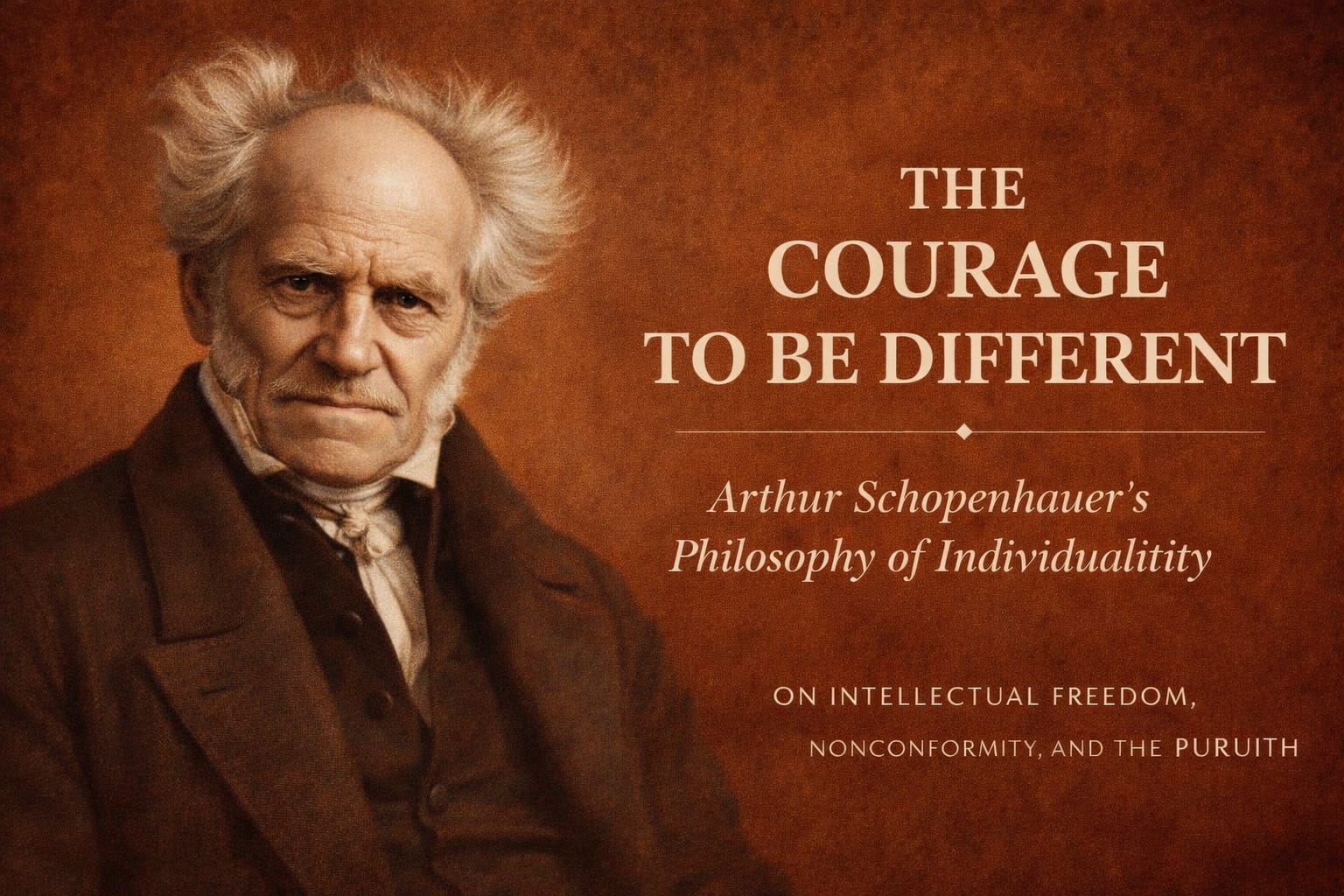
THE COURAGE TO BE DIFFERENT
Arthur Schopenhauer’s philosophy of individuality

The Power of Solitude: Reclaiming the Self in a Noisy World
There is a sacred place in everyone’s life, a room, a quiet corner, a space that keeps them away from the noise of society. Those who learn to use that space come to understand something rare: the strength and clarity that solitude provides.
For many, this realization begins with discomfort. The feeling of being alone in a crowd, surrounded by the wrong people, often leads one to withdraw. What appears at first to be retreat gradually becomes restoration. In stepping away, something essential returns, clarity, peace, and a sense of self that had been slowly fading.
This insight is central to the philosophy of Arthur Schopenhauer, who regarded solitude not as avoidance, but as a necessary condition for authenticity.
The Cost of Society
Constraint is always present in society like a companion of whom there is no riddance.
Schopenhauer begins with a direct observation: the moment we enter society, we are no longer entirely ourselves. Every interaction requires adjustment. Tone is moderated, thoughts are filtered, and behavior is shaped by expectations.
The pressure to conform is constant.
These compromises may seem minor, but over time they accumulate. Society, by its nature, limits individuality. For many, this feels normal. For those who value depth and independence of thought, it becomes a burden.
Not all company enriches. Some of it diminishes.
As he puts it, they rob him of himself and give him nothing to compensate for the loss.
Loss without return.
Solitude restores what society disperses. In isolation, a person is no longer divided between inner truth and outward performance.
A person is just what he is.
A man can be himself only so long as he is alone.
Every social interaction demands something, politeness, restraint, compromise. Over time, this leads to:
The erosion of authentic expression.
In solitude, that pressure disappears. What remains is freedom.
Schopenhauer compares society to a fire: at the right distance, it provides warmth; too close, it causes harm. The task is not to reject society, but to maintain the right distance from it.
A similar idea appears in the thought of Friedrich Nietzsche:
Flee my friend into thy solitude.
The noise of the great men and the stings of the little ones.
Excessive exposure to this noise weakens clarity and identity. Solitude, by contrast, creates the conditions for focus and growth.
A shift toward inner fulfillment.
With time, solitude no longer feels like isolation. It becomes natural.
It becomes the element proper to his life as water to a fish.
This longing for peace is also expressed in the work of Fyodor Dostoevsky:
“I want peace. I’d sell the whole world for a farthing straight off so long as I was left in peace.”
The Fate of Great Minds
To be alone is the fate of all great minds.
Schopenhauer argues that solitude and intellectual depth are closely linked.
Grateful to have you in Reason Vault, a space built on curiosity, reflection, and meaning
Greatness often leads to isolation.
The more a person reflects, questions, and sees beyond appearances, the more distant they may feel from ordinary social life. In youth, this distance can feel like alienation. With time, it becomes understanding.
Solitude serves as protection. It removes trivial distractions and allows sustained attention.
Space to think. Space to question. Space to pursue truth.
He compares such individuals to eagles building nests in high, unreachable places, removed from the noise below.
Intellectual superiority offends society by its very existence.
Original thinkers are often misunderstood or dismissed. Solitude becomes a way to preserve independence of mind.
We lose 3/4s of who we are simply to avoid being seen as strange or boring.
For a reflective person, this compromise is unsustainable. Withdrawal becomes a deliberate choice.
Over time, social circles become smaller and more selective. Solitude shifts from preference to habit.
History reflects this pattern. Figures such as Isaac Newton, Ludwig van Beethoven, and Immanuel Kant developed their most significant work in relative isolation.
The more a man has in himself, the less others can be to him.
Peace and the Role of Solitude
Perfect tranquility of soul next to health is the highest blessing the earth can give and this is to be attained only in solitude.
Inner calm is among the highest forms of well-being. According to Schopenhauer, it is rarely found in social environments.
“Almost all our sufferings spring from having to do with other people.”
Much of human distress, conflict, disappointment, emotional strain, arises from interaction.
Society as a source of disturbance.
Solitude offers an alternative: stability and protection.
Solitude is doubly advantageous.
It allows a person to remain with themselves while reducing exposure to external pressures. In this state, the mind becomes steady.
Schopenhauer also suggests cultivating an inward form of solitude, remaining mentally independent even when physically present among others.
A form of inner resilience.
While solitude has its own challenges, they are minor compared to the strain created by constant social engagement.
To be soon on friendly or even affectionate terms with solitude is like winning a gold mine.
And further:
Solitude is the sole condition of life which gives full play to that feeling of exclusive importance which every man has in his own eyes.
This sense of exhaustion with society appears in literature as well:
“What more do you want?”
Not anger, but fatigue.
Pain and suffering are always inevitable for a large intelligence and a deep heart.
Schopenhauer expresses his view without moderation:
There are everywhere crowds of people not worth talking to.
The world is Bethlehem. Solitude is Egypt. Flee my soul. Flee or else you will die of sorrow.
The Danger of Company
Rascals are always sociable. More is the pity.
The company one keeps has a direct influence on thought and character.
Schopenhauer presents a clear tension:
Solitude or conformity.
In many environments, authenticity is discouraged. It must be adjusted or concealed.
People are expected to exhibit an unlimited amount of patience towards every form of folly and stupidity, whilst personal merit has to beg pardon or else conceal itself altogether.
Foolishness is often tolerated, while depth and intelligence are restrained.
A gradual loss of self.
Over time, this becomes more than adaptation; it becomes transformation.
This idea is echoed by Jean-Paul Sartre:
“Hell is other people.”
Social environments can flatten differences, making excellence less visible or even unwelcome.
Bad company is not neutral.
It is influential.
It shapes thinking, alters priorities, and redirects values.
The practical conclusion is not complete isolation, but careful selection.
Limit your circle.
As Seneca observed:
If a man’s company is not better than solitude, do not seek it.
Conclusion
Solitude is often mistaken for loneliness. In reality, it is a condition for clarity, independence, and inner stability. It provides the space in which thought deepens, identity strengthens, and peace becomes possible.
In a world defined by constant interaction and expectation, the ability to step back is not withdrawal, it is discipline. And in that discipline lies the possibility of becoming fully oneself.
DONATE WITH COFFEE ☕️

If this piece resonated with you, your small gesture can help me keep writing, a cup of coffee goes a long way.☕
Schopenhauer's praise of solitude as a source of clarity is compelling—it's a vital refuge from the crowd. Yet that is where it ends for me.
René Girard flips the script beautifully, though: our mimetic (imitative) desire is what makes culture, language, and genuine human connection possible in the first place. Instead of seeing community as mostly harmful, we can redirect that imitation toward positive, non-rivalrous models—creating bonds that foster creativity and compassion without the usual rivalry. Solitude for clarity, community for flourishing: both have their place.
I find that I naturally desire to set myself apart from the group. To stand out. While many desire conformity and belonging, for some reason, I desire to be the different one. Perhaps this desire is a coping mechanism for naturally diverging, or it’s a natural desire because of my endowed temperament