
From Despair to Greatness
The Transformative Journey of Fyodor Dostoevsky How Suffering and Redemption Forged a Literary Genius

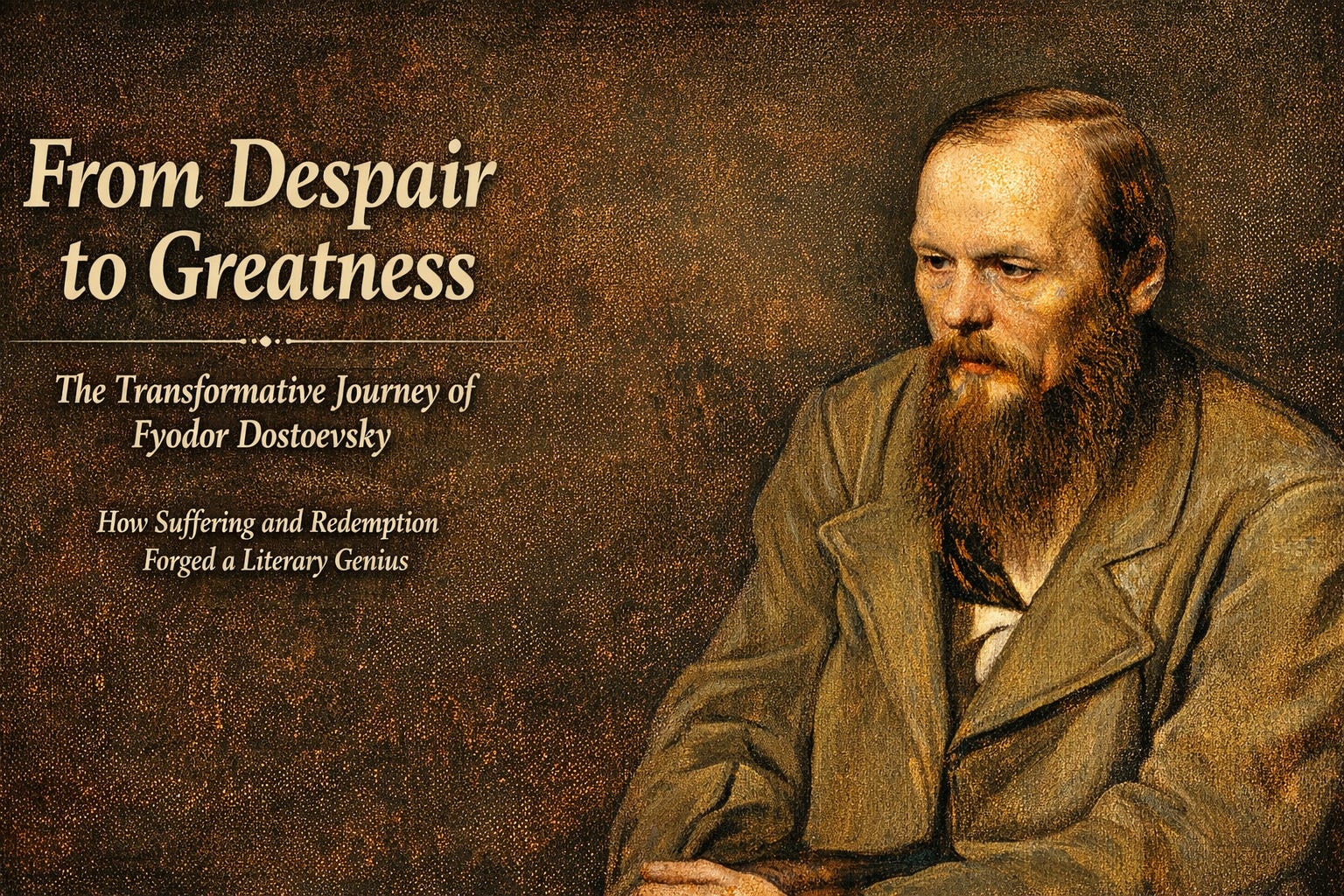
Standing Before Death: How Fyodor Dostoevsky Was Reborn
From a Mock Execution to the Depths of the Human Soul
“I lived with that thought for three quarters of an hour. I faced the last moment, and now I am alive again.”
These haunting words were written by Fyodor Dostoevsky after one of the most terrifying experiences of his life: his mock execution in 1849.
At just twenty-seven years old, Dostoevsky had been sentenced to death by firing squad for his involvement in a liberal literary circle. He was led to the execution grounds, dressed in a white shroud, made to kiss the cross, and placed before the rifles.
At the very last moment, a messenger arrived with a decree from the Tsar. The execution was stopped.
Dostoevsky had been spared.
What the prisoners did not know was that this entire execution had been staged. The spectacle was designed to break their spirits and demonstrate the absolute authority of the Russian Empire.
For Dostoevsky, however, the moment became something else entirely. It was not merely survival.
It was a rebirth.
The Firing Squad and a New Vision of Life
In 1849, Dostoevsky had joined the Petrashevsky Circle, a group of intellectuals who met privately to discuss banned Western philosophy and political reform.
In Tsarist Russia, such conversations were dangerous. The secret police eventually arrested the group, accusing them of spreading subversive ideas.
On December 22, 1849, the prisoners were taken to Semyonovsky Square in St. Petersburg. One by one, their death sentences were read aloud.
Blindfolded and waiting before the firing squad, Dostoevsky believed he had only moments left to live.
Then came the announcement of a last-minute pardon from Tsar Nicholas I.
Instead of execution, Dostoevsky’s sentence was commuted to four years of hard labor in Siberia followed by compulsory military service.
The experience permanently altered his understanding of life.
“Life is everywhere. Life is in us. Not to lose heart and not to grow despondent. Life is a gift. Life is happiness. Each moment could have been an eternity of happiness.”
Standing at the threshold of death had awakened in him a profound reverence for life, humanity, and spiritual endurance.
Siberia: Suffering as Transformation
After the terror of the execution square, Dostoevsky’s punishment truly began.
He spent four years in a Siberian prison camp near Omsk, enduring some of the harshest conditions imaginable.
Prisoners lived in chains alongside murderers and thieves. They faced freezing winters, relentless labor, hunger, disease, and brutal punishment.
For many men, such conditions would destroy the spirit.
For Dostoevsky, they became a crucible of transformation.
The experience later inspired his semi-autobiographical work “Notes from the House of the Dead.” In it, he described the harsh realities of prison life: cruel guards, violent inmates, and the psychological weight of captivity.
Yet the most profound change occurred within him.
Living among criminals forced him to abandon his earlier prejudices. Slowly, he began to see the humanity even in the most broken individuals.
Moments of dignity, humor, and compassion appeared even within the bleakest surroundings.
These revelations reshaped his worldview. The young intellectual who had once believed in abstract political ideals became something different: a witness to suffering and a seeker of meaning within it.
During his imprisonment, Dostoevsky also began experiencing epileptic seizures, a condition that would accompany him throughout his life. He later referred to it as his “sacred disease.”
This personal suffering would later shape characters such as Prince Myshkin in his novel “The Idiot.”
The Destructive Temptation of Gambling
When Dostoevsky returned from exile, freedom did not immediately bring stability.
Instead, he developed a dangerous obsession with gambling.
During his travels in Europe, he became captivated by roulette. What began as curiosity soon turned into addiction.
Time and again he lost everything he possessed—even money meant to support his family. The cycle of hope and despair drove him deeper into debt and emotional turmoil.
By 1865, he was nearly penniless.
In desperation, he signed a severe contract with the publisher Fyodor Stellovsky. If Dostoevsky failed to deliver a new novel by November 1, he would lose the publishing rights to all his future works for nine years.
To meet the deadline, he hired a young stenographer named Anna Grigorievna Snitkina.
Working intensely together, Dostoevsky dictated a novel at extraordinary speed. The result was “The Gambler,” a story that closely mirrored his own destructive relationship with roulette.
Against all odds, the manuscript was completed just before the deadline.
The crisis unexpectedly transformed his life in another way as well.
Dostoevsky fell in love with Anna.
They married in 1867, and she became far more than his wife. She was his editor, financial manager, and unwavering emotional support.
With her guidance, Dostoevsky gradually regained control of his life.
Love, Loss, and Literary Greatness
Even with newfound stability, tragedy continued to shadow him.
In 1864, his first wife Maria Dmitrievna died of tuberculosis. That same year, his beloved brother Mikhail also passed away.
These devastating losses plunged Dostoevsky into grief and financial difficulty.
Yet from this suffering emerged one of the greatest novels ever written.
“Crime and Punishment,” published in 1866, explored guilt, alienation, and the moral struggle for redemption. Many scholars see clear parallels between Dostoevsky’s personal anguish and the inner torment of the novel’s protagonist, Raskolnikov.
Dostoevsky himself admitted that he wrote the novel:
“honestly from my own wounds and sufferings.”
The book became an immediate success.
In the years that followed, he continued producing works of remarkable psychological depth. “The Idiot” explored the possibility of pure goodness in a corrupt society through the character Prince Myshkin.
Meanwhile, “Notes from Underground” offered a dark exploration of alienation, resentment, and the contradictions within the human mind.
By the late 1860s, Dostoevsky had accomplished something extraordinary.
He had transformed every personal catastrophe—poverty, imprisonment, illness, addiction, and grief—into profound literature.
What emerged from his suffering was not bitterness, but a deep and compassionate understanding of the human soul.
A Life Devoted to Understanding Humanity
Dostoevsky once wrote a line that captures the essence of his life and work:
“Man is a mystery. It needs to be unraveled. And if you spend your whole life unraveling it, do not say that you have wasted time.”
For Dostoevsky, literature was never merely storytelling.
It was an attempt to explore the deepest questions of existence—guilt, suffering, faith, freedom, and redemption.
His life proved that even the darkest experiences can become the foundation of profound insight.
Standing before death on a freezing morning in St. Petersburg, Dostoevsky believed his life was ending.
Instead, it had only just begun.
Conclusion
The life of Fyodor Dostoevsky is one of the most remarkable examples in literary history of how human suffering can be transformed into profound insight. Few writers have faced the kind of trials he endured. He stood moments away from death before a firing squad, spent years in brutal Siberian prison camps, suffered from illness and poverty, struggled with addiction, and endured devastating personal losses. Yet rather than allowing these experiences to destroy him, Dostoevsky used them to deepen his understanding of life, morality, and the human soul.
What makes Dostoevsky extraordinary is not simply that he survived these hardships, but that he turned them into art of unmatched psychological depth. His novels are not merely stories; they are explorations of the most fundamental questions of human existence. Through characters such as Raskolnikov, Prince Myshkin, and the Underground Man, Dostoevsky examined guilt, freedom, faith, despair, redemption, and the inner contradictions that define the human condition.
Standing on the edge of death in the winter of 1849 changed him forever. In that moment, life revealed itself to him with a clarity few people ever experience. Every breath, every relationship, every moment of existence suddenly appeared precious. That encounter with mortality awakened within him a deep reverence for life and a lifelong fascination with the mysteries of the human spirit.
The years in Siberia further transformed him. Living among prisoners—men whom society had labeled monsters—he discovered something that would shape his philosophy and his literature: even in the most broken individuals, there remains a spark of humanity. This realization gave his writing a compassion and moral complexity that continues to resonate with readers across generations.
Even his personal weaknesses, particularly his destructive addiction to gambling, became part of the creative force behind his work. Instead of hiding from his failures, Dostoevsky confronted them honestly and transformed them into stories that reveal the fragile and contradictory nature of human desire. In this way, his literature reflects not a perfect man, but a deeply flawed one who struggled to understand himself and the world around him.
Perhaps this is why Dostoevsky’s works remain so powerful today. They do not offer easy answers or simple moral lessons. Instead, they invite readers to confront the darkness, beauty, and mystery of the human soul. His novels remind us that people are capable of both cruelty and compassion, despair and redemption, destruction and transformation.
Dostoevsky once wrote:
“Man is a mystery. It needs to be unraveled. And if you spend your whole life unraveling it, do not say that you have wasted time.”
This statement reflects the essence of his life and work. For Dostoevsky, understanding humanity was a lifelong pursuit—one that required confronting suffering, doubt, and moral struggle. His writing continues to challenge readers to look inward, to question their assumptions, and to recognize the complexity that lies within every human being.
In the end, Dostoevsky’s life offers a powerful lesson. The moments that appear darkest—those filled with pain, loss, and despair—are not always the end of the story. Sometimes they are the beginning of transformation. The young man who once believed he would die before a firing squad eventually became one of the greatest voices in world literature.
His story reminds us that even the most painful experiences can become the source of wisdom, empathy, and creativity. And perhaps that is the deepest truth Dostoevsky leaves behind: that within every human life, no matter how broken or troubled it may seem, there exists the possibility of meaning, redemption, and renewal.