
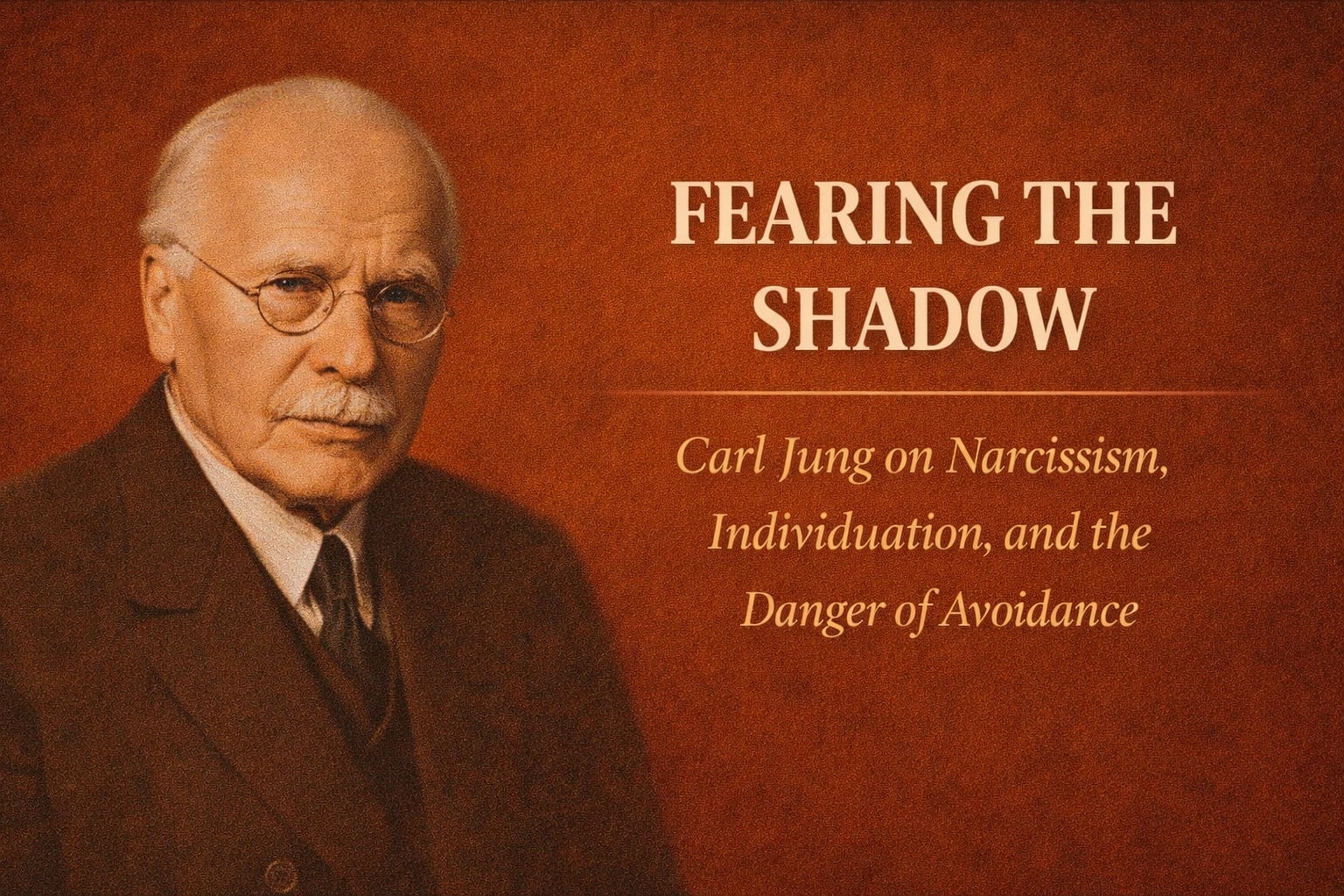
FEARING THE SHADOW
Carl Jung on Narcissism Individuation, and the Danger of Avoidance

The Narcissist’s Shadow: Control, Illusion, and the Fear of the Self
Why the refusal to confront our inner darkness leads to fragmentation, not strength
“No tree can grow to heaven unless its roots reach down to hell.” — Carl Jung
There is a certain kind of person we have all encountered, the one who believes that wrongdoing belongs exclusively to others, while virtue resides solely within themselves. They carry an air of moral elevation, as if they have already “arrived,” placing themselves above criticism, above change, and often, above others.
What makes this disposition troubling is not merely arrogance, but blindness.
They fail to recognize a fundamental psychological truth: they, too, possess a dark side.
This refusal lies at the heart of what modern psychology identifies as narcissistic personality disorder (NPD). Yet to understand narcissism purely as a clinical condition is to overlook something deeper. Narcissism functions less like a static disorder and more like a psychological addiction, an ongoing dependence on control, validation, and the maintenance of a carefully constructed self-image.
Like any addiction, it distorts perception. The narcissist’s sense of control is not grounded in reality, but in their ability to influence how others feel, think, and respond. Emotional manipulation becomes not just a strategy, but a necessity.
The Shadow: What We Refuse to See
The concept of narcissism was first formally introduced by Sigmund Freud in 1914. However, a deeper and more symbolic understanding emerges through the work of Carl Jung, particularly through his idea of the shadow.
The shadow represents the unconscious aspects of the personality, the parts of ourselves that we repress, deny, or fail to acknowledge. These may include traits we consider undesirable, such as anger, jealousy, or selfishness. But the shadow is not limited to negativity; it can also contain unrealized strengths, creativity, and suppressed potential.
Jung emphasized a crucial point: the shadow is not inherently evil. It becomes dangerous only when it is ignored.
“To become conscious of it involves recognizing the dark aspects of the personality as present and real.”
This recognition requires effort. It demands honesty, self-awareness, and the willingness to confront uncomfortable truths about oneself. It is precisely this confrontation that the narcissist avoids.
The Construction of the Inflated Self
Narcissism does not emerge in isolation. It is often rooted in early developmental experiences, particularly those shaped by extreme forms of parenting.
In environments marked by harsh criticism, a child may internalize feelings of inadequacy and shame. To cope, they construct an inflated self-image, a psychological shield designed to protect against perceived worthlessness.
Conversely, excessive praise can produce a similar outcome. When a child is consistently elevated without grounding, they may develop an unrealistic sense of superiority. Their self-worth becomes dependent on admiration rather than authenticity.
Despite their differences, both paths lead to the same destination:
A fragile identity sustained by an inflated ego.
Beneath the surface of confidence lies vulnerability, unexamined, unintegrated, and unresolved.
Persona: The Mask That Replaces the Self
Jung described the persona as the social mask an individual presents to the world. It is shaped by expectations, roles, and cultural norms, and in moderation, it is necessary for functioning within society.
For the narcissist, however, the persona becomes more than a mask.
It becomes the self.
The individual constructs an image of perfection, confident, superior, and emotionally invulnerable. Over time, they identify so completely with this image that they lose contact with their authentic inner world.
The persona, once a tool, transforms into a defense mechanism. It conceals insecurity, suppresses vulnerability, and maintains the illusion of control. In doing so, it deceives not only others, but the individual themselves.
What is hidden beneath this mask is often a fragmented and fragile identity, unable to withstand introspection.
Grateful to have you in Reason Vault, a space built on curiosity, reflection, and meaning.
The Illusion of Control
In Jungian terms, the narcissist often reflects a distorted expression of the magician archetype, not as a figure of transformation, but as one of manipulation.
Rather than seeking genuine self-understanding, the narcissist reshapes reality to maintain admiration and authority. Their power lies not in growth, but in illusion.
“People will do anything, no matter how absurd, to avoid facing their own souls.”
This avoidance leads to a profound internal consequence: disconnection.
When stripped of external validation, the narcissist often encounters a sense of emptiness. The carefully constructed identity begins to falter, revealing the instability beneath.
Jung captured this condition with precision:
“Loneliness does not come from having no people about one but from being unable to communicate the things that seem important to oneself.”
The Resistance to Individuation
At the center of Jung’s psychology lies the concept of individuation, the lifelong process of integrating the conscious and unconscious aspects of the self.
Individuation requires the acknowledgment of imperfection. It calls for the integration of the shadow, the acceptance of vulnerability, and the reconciliation of internal contradictions.
For the narcissist, this process is resisted.
Their attachment to an idealized self-image prevents genuine introspection. Confronting the unconscious would mean dismantling the very identity they rely upon for psychological stability.
As a result, growth is replaced by stagnation.
The persona, once protective, becomes restrictive.
The mask becomes a prison.
Beyond Pathology: A Nuanced View of Narcissism
Jung’s perspective on narcissism extends beyond pathology. He recognized that certain forms of narcissism can serve adaptive and even necessary psychological functions.
Compensatory narcissism, for example, arises during periods of vulnerability. It acts as a temporary defense, helping individuals restore a sense of control and self-worth in the face of insecurity.
Similarly, healthy narcissism plays a vital role in development. It fosters self-respect, confidence, and the ability to establish boundaries. Unlike its pathological counterpart, it does not deny imperfection but integrates it.
Healthy narcissism supports resilience. It allows individuals to value themselves without losing connection to reality or others.
The Final Reflection
At its core, narcissism is not simply a condition of excess ego.
It is a condition of avoidance.
Avoidance of pain.
Avoidance of vulnerability.
Avoidance of the unconscious self.
And yet, the paradox remains: what is avoided does not disappear, it deepens, distorts, and ultimately demands recognition.
Jung’s final insight serves as both warning and invitation:
“A man likes to believe that he is the master of his soul. But as long as he is unable to control his moods and emotions, or to be conscious of the myriad secret ways in which unconscious factors insinuate themselves into his arrangements and decisions, he is certainly not his own master.”
To confront the self is difficult. To integrate it is harder still.
But without descending into our own depths, we can never truly rise.
DONATE WITH COFFEE ☕️

If this piece resonated with you, your small gesture can help me keep writing, a cup of coffee goes a long way.☕
the observation that both harsh criticism and excessive praise produce the same fragile identity is the part most people will not sit with long enough. we understand how neglect creates damage. the idea that admiration can produce the same architecture of avoidance is the part that threatens the entire self-esteem industry.
what jung identified about the persona becoming the self rather than serving it maps onto something observable in any relationship with a narcissist - the performance is not a choice. it is the only structure left standing. when someone has identified so completely with the mask that removing it feels like annihilation, you are no longer dealing with dishonesty. you are dealing with a person whose authentic self was never given permission to exist. the cruelty is real. but the mechanism underneath it is not strength. it is a system that learned that vulnerability equals destruction and built every subsequent interaction around ensuring that lesson was never tested.
avoidance does not prevent the reckoning. it just determines whether it happens on your terms or the shadow's.